Plan · field notes
Best Time to Visit Xcaret (Crowds, Rain, Prices by Month)
DisclosureWe write from our own family trip. Some links are affiliate or referral links; if you use them we may earn a small commission or reward points, at no extra cost to you. Where that applies we say so on the page. It never changes what we recommend.
Most "best time to visit" pages are written by nobody who went at any time. This one is written by a family that went once, July 13 to 18, 2026, and is honest about the seam: the July section below is experience; everything else is research, linked to its sources so you can check us.
What July was actually like (the part we lived)
The forecast looked scary and the trip wasn't. It rained twice in five nights, and both showers passed in minutes. The heat was real but the water is everywhere: rivers, pools, the cold underground rivers at the park, which stayed cold even in the hottest month of the year. Pack for wet, not for ruined days.
Crowds surprised us in the other direction. Our trip straddled the start of Mexico's school summer break (classes ended nationwide on July 15, mid-stay), and the property still never felt crowded to us. Everything at Hotel Xcaret México is spread far enough apart that we walked into two dinners without reservations, including the best meal of the trip.
And one real price point, since summer is supposedly cheap season: five nights for two adults, a teen, and a four-year-old, booked direct, was $6,058.15 in July 2026. Use that as your calibration when a rate quote comes back.
The honest July tradeoffs, from the data rather than our luck: it sits inside hurricane season (Beryl hit this coast as a Category 2 in July 2024), and it's peak sargassum window in a bad sargassum era.
The month-by-month table
Climate figures are from Climates to Travel's Playa del Carmen dataset; crowd notes only where a documented driver exists. Where we found no citable data, the cell says so instead of guessing.
| Month | Avg high | Rain | Sargassum (typical) | Crowds (documented drivers) |
|---|---|---|---|---|
| Jan | 82 F / 27.6 C | 75 mm, 6 days | Low | High to Jan 6 (Mexican school break), then easing |
| Feb | 83 F / 28.4 C | 55 mm, 5 days | Low | Winter peak; spring break begins late month |
| Mar | 84 F / 29.1 C | 40 mm, 3 days | Low, season nears | High: US spring break peaks weeks 2 and 3 |
| Apr | 86 F / 30.4 C | 45 mm, 3 days | Building | High during Semana Santa (in 2027: Mar 22 to Apr 2) |
| May | 89 F / 31.6 C | 110 mm, 7 days | High | No documented driver found |
| Jun | 89 F / 31.8 C | 190 mm, 12 days | Peak | No documented driver found |
| Jul | 90 F / 32.5 C | 120 mm, 12 days | Peak | High from mid-month (Mexican summer break) |
| Aug | 91 F / 32.8 C | 145 mm, 13 days | High, easing late | High (summer break to about Aug 30) |
| Sep | 90 F / 32.0 C | 235 mm, 15 days | Easing | Low (occupancy trough; cheapest NYC flights) |
| Oct | 88 F / 30.9 C | 215 mm, 13 days | Ending | Low, rising at month-end for the festival |
| Nov | 84 F / 29.1 C | 105 mm, 7 days | Low | Festival to about Nov 2; Thanksgiving week spike |
| Dec | 82 F / 28.1 C | 95 mm, 7 days | Low | Very high from Dec 21 (holiday break to Jan 6) |
Sea temperature runs from about 79 F (26 C) in January through March up to about 84 F (29 C) in August and September. It's swimmable all year; winter is just the cool end.
Hurricane season, without the drama
The official Atlantic season is June 1 to November 30, with a statistical peak on September 10, per NOAA's National Hurricane Center, and most activity lands between mid-August and mid-October. The recent local record matches: every direct hurricane landfall on this coast since 2020 came in July, August, or October (Delta and Zeta in October 2020, Grace in August 2021, Beryl in July 2024). For 2026 specifically, NOAA's May outlook called for a below-normal season, which is an outlook, not a promise. The practical version: a summer or fall trip is a fine bet most years, and travel insurance plus flexible bookings is the correct hedge, not avoidance.
Sargassum: the real beach variable
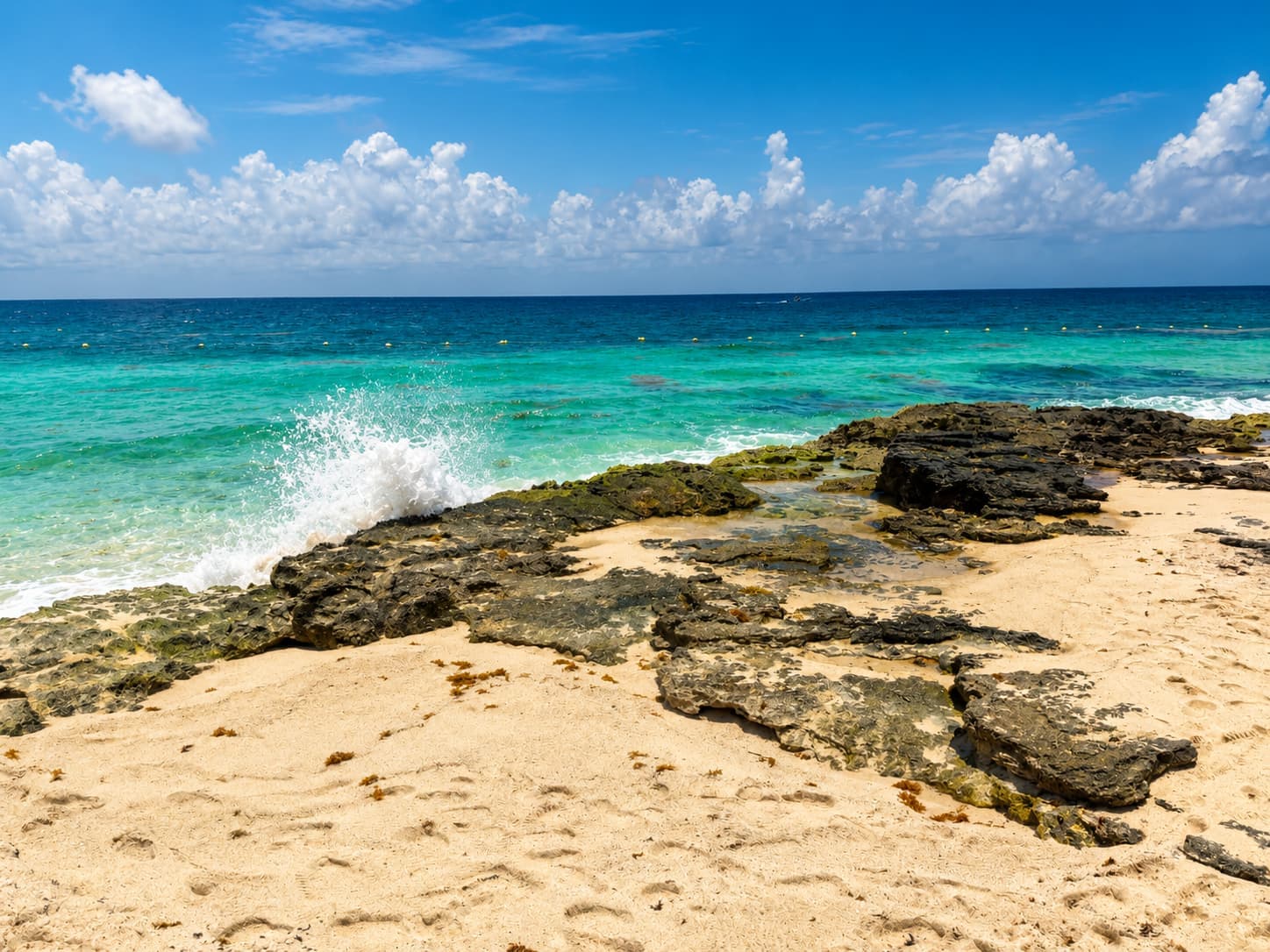
Seaweed, not storms, is the thing most likely to change what your beach days look like. The typical Mexican Caribbean season runs roughly April through October and is clearest November through February, and 2026 is running at or near record levels per the University of South Florida's monitoring lab. Two useful facts for Xcaret specifically: the park has publicly described a daily cleanup operation (aerial monitoring at 6:30 a.m., a large crew clearing swim areas before opening), and sargassum is an ocean-shoreline phenomenon; the inland rivers and pools you'll spend most of your water time in are not open beachfront.
01The river inlet meeting the sea at the hotel, July 2026.
Before you go, check the USF Sargassum Watch System and the Red de Monitoreo del Sargazo for live conditions.
The crowd calendar
The documented spikes, with dates you can plan around:
- US spring break: late February through early April, peaking the second and third weeks of March.
- Semana Santa: Mexico's biggest travel week. The official school calendar puts the 2027 break at March 22 to April 2.
- Mexican summer break: roughly mid-July through the end of August (the 2026-27 school year starts August 31).
- The holidays: December 21 through January 6, the year's peak. State tourism data reported the Riviera Maya in the 80 to 89 percent occupancy range at the 2025 year-end, versus roughly 70 to 75 percent in midsummer.
- Thanksgiving week (November 26 in 2026) is a short, sharp US spike.
Quintana Roo's tourism office publishes a live daily occupancy dashboard if you want to check the temperature of the crowds before you book.
One Xcaret-specific date that cuts the other way: the Festival de Tradiciones de Vida y Muerte, the park's Day of the Dead festival, historically October 30 to November 2. It adds crowds and is also, by most accounts, the single most special time to be in the park. 2026 dates were unannounced when we researched this; check the official site.
So when should you go?
The three curves (rain and hurricanes, sargassum, crowds and prices) do not bottom out in the same month, so the honest answer is three answers:
Whenever you go, the advice that survived our trip: book the parks ahead, build the rest day in the middle, and treat the weather forecast as a suggestion. July's scary forecast cost us fifteen total minutes of rain. Check the current options for Xcaret hotelsad and Xcaret Park admissionad for your dates.
Researched July 23, 2026. Climate normals are stable; sargassum forecasts, hurricane outlooks, and festival dates move, and we re-check this page when they do.
Frequently asked questions
What is the best month to visit Xcaret?
There is no single best month; the rain, sargassum, and crowd curves bottom out at different times. Late November to early December is the closest thing to a sweet spot in the data: hurricane season over, sargassum at its low, rain falling off, and a quiet gap between Thanksgiving and the December 21 holiday surge.
When is the cheapest time to visit Xcaret?
September and October, per converging rate data. Kayak and Expedia both put hotel lows in early fall, and Google Flights route data shows September as the typical cheapest month to fly from New York. The tradeoff: those are also the wettest months, inside the statistical heart of hurricane season.
Should you worry about hurricane season?
Respect it, don't fear it. The Atlantic season runs June 1 to November 30 with a statistical peak on September 10 per NOAA. Every direct hit on this coast since 2020 (Delta, Zeta, Grace, Beryl) came in July, August, or October. We went in July with travel insurance and got two brief showers.
What months have sargassum at Xcaret?
The typical Mexican Caribbean season runs roughly April through October, peaking in early summer; November through February is most reliably clear. 2026 has been a near-record year. It affects ocean shorelines; the park says it clears its coves every morning, and pools and rivers are not open beachfront.
How many days is enough for Xcaret?
We stayed five nights, did three parks and a resort day, and still didn't finish. Five nights is the minimum we'd book again; our day-by-day log shows exactly where the time went.